

Encrypting an estate is the easy half. The hard half is the question every digital inheritance system eventually runs into: how do you know the owner is actually gone, and how do you release access at that exact point, no earlier and no later, without handing the keys to someone who could misuse them?
Release too early and you have built a way for a bad actor to claim a living person's assets. Release too late, or behind a single human gatekeeper, and the family is stuck waiting on one person's cooperation. VaultRelay is BlockWill's answer to that problem. It is the mechanism that decides the moment of inheritance, and it is built so that no single party, including BlockWill, can force or fake that moment alone.
What "trustless" actually means here
Trustless does not mean no one is involved. It means the system does not depend on trusting any one person to be honest or available. Instead of one gatekeeper holding the keys, the ability to release is split so that it takes a defined combination of conditions and people to unlock, and any single one of them acting alone cannot.
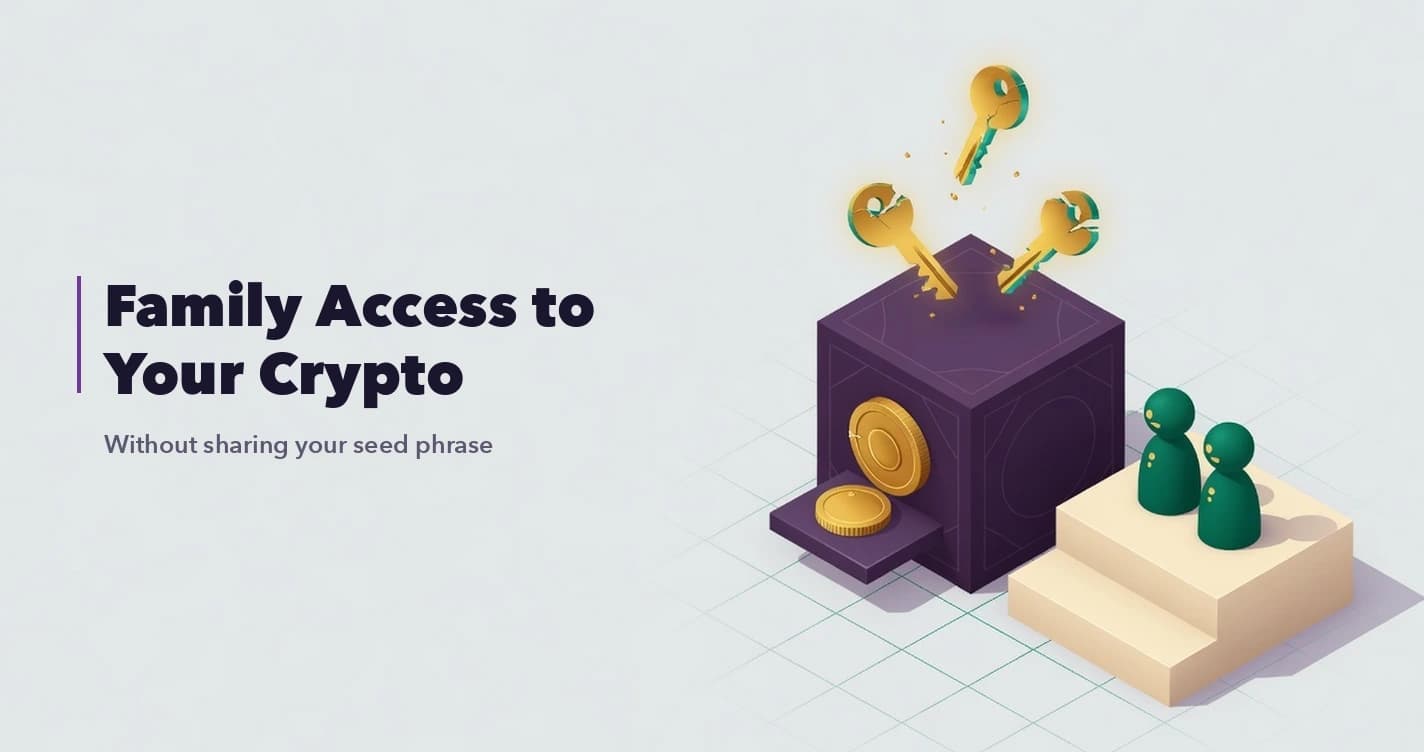
Concretely, the decryption material that lets a beneficiary into your vault does not sit whole on a server waiting for someone to flip a switch. It is split into shares using a technique called Shamir's Secret Sharing, where a secret is divided into several pieces and a set threshold of them (say, three of five) must be combined to reconstruct it. No piece on its own reveals anything. BlockWill never holds enough pieces to open your vault by itself.
The triggering conditions
VaultRelay can be configured with more than one path to release, because real life does not have a single clean signal that someone has died. You choose the combination that fits your situation. The common building blocks are these.
Inactivity timer. You set a period of silence (for example, 90 days). BlockWill checks in with you on a schedule. You confirm you are fine with a single tap, or a passkey check. If you stop responding for the full window, after repeated reminders across email, SMS, and any backup contacts, that silence becomes one of the signals toward release. The timer is deliberately long and noisy, so a person on a long trip or in hospital is not at risk of an accidental trigger.
Executor confirmation. You designate one or more executors. When the time comes, an executor submits a confirmation, typically supported by documentation such as a death certificate. Their confirmation is a signal, but on its own it is not enough to open the vault, which protects you against a single dishonest or mistaken executor.
Beneficiary and multi-party checks. Depending on your configuration, release may require agreement across more than one designated party, so that the combination, not any one person, crosses the threshold.
The point of layering these is that no single failure or single bad actor produces a release. A hacked email account does not do it. A pushy relative does not do it. An employee at BlockWill cannot do it. Release happens only when the configured combination of independent signals lines up.
How a release actually unfolds
When the conditions begin to be met, VaultRelay does not silently open the doors. It runs a visible, logged process.
First, the trigger is proposed, either by the inactivity timer expiring or by an executor submitting a confirmation. Second, a notification and challenge period begins. Everyone relevant (you, if you are somehow still reachable, plus executors and backup contacts) is alerted, and there is a window in which a living owner can cancel the whole thing with a single authenticated action. This is the safety catch: if you are alive and this is a false alarm, one tap stops it.
Third, if the challenge period passes and the threshold of conditions is satisfied, the key shares are brought together and the wrapped vault keys are released to the verified beneficiaries. They authenticate, and the vault is decrypted in their browser using keys provisioned for them during setup. Fourth, every step is written to an immutable audit log, so the entire sequence (who confirmed what, when each signal arrived, when release occurred) can be reviewed later and disputed if something looks wrong.
Why BlockWill cannot cheat this
This is the property that matters most, so it is worth stating plainly. BlockWill cannot open your vault on its own, and BlockWill cannot trigger an inheritance on its own. We do not hold a complete copy of your keys, and we do not hold enough secret shares to reconstruct them. Our role is to run the process honestly and to enforce the rules you set, not to hold a master key.
That is what "trustless" buys you. You are not asked to believe that BlockWill will behave well in perpetuity, or that no future employee will ever go rogue, or that the company will exist unchanged for fifty years. The cryptography enforces the limits regardless of our behavior. If our servers were breached tomorrow, the attacker would find split shares and encrypted blobs, not a button labeled release.
Configuring VaultRelay for your estate
Setup walks you through three decisions. Who your executors and beneficiaries are. What the release threshold should be (how many independent signals it takes). How long the inactivity window and challenge period should be. The defaults are conservative, favoring long windows and loud reminders, because the cost of releasing too early is far worse than the cost of releasing a little late.
You can revise any of this while you are active. People change, executors change, families change. VaultRelay is meant to be reviewed every year or two, the same way you would revisit a will.
Frequently Asked Questions
What is VaultRelay?
VaultRelay is BlockWill's inheritance trigger system. It decides when your digital estate is released to your beneficiaries, based on conditions you configure such as an inactivity timer and executor confirmation, and it releases access only when a defined threshold of those conditions is met.
What does trustless mean in VaultRelay?
It means release does not depend on trusting any single person or on BlockWill holding your keys. The decryption material is split into shares using Shamir's Secret Sharing, and a threshold of independent signals is required, so no one party, including BlockWill, can open your vault alone.
What stops my estate from being released while I am still alive?
Several safeguards. The inactivity timer is long and sends repeated reminders, executor confirmation alone is not sufficient, and there is a challenge period during which you can cancel any pending release with a single authenticated action. Release requires a combination of signals, not one.
Can a BlockWill employee trigger my inheritance?
No. BlockWill does not hold enough key shares to reconstruct your vault keys and cannot satisfy the release threshold on its own. The system enforces this with cryptography, not policy.
What is an inactivity timer?
It is a period of silence you define, such as 90 days. BlockWill checks in on a schedule and you confirm you are fine. If you stop responding for the full window despite repeated reminders, that becomes one of the signals toward release.
Who can be an executor?
Anyone you designate. An executor submits confirmation of a triggering event, usually with supporting documentation. Their confirmation is one input into the release decision, not the whole decision.
Is everything recorded?
Yes. Every step of a release is written to an immutable audit log, including which signals arrived and when release occurred, so the process can be reviewed or challenged afterward.
How is this different from just giving someone my password?
A shared password gives one person full access right now, with no controls, no timing, and no record. VaultRelay releases access only on a confirmed event, requires a combination of independent signals, lets you cancel false alarms, and logs everything. It is inheritance, not a handover.
Further reading:
- SecureVault Walkthrough: Uploading Your First Sensitive Document, how the documents VaultRelay releases are encrypted in the first place.
- Onboarding a Beneficiary: A Product Design Story, what the person on the receiving end of a VaultRelay release actually experiences.